

Getting an endometriosis diagnosis while you’re trying to conceive can feel like the rug got pulled out from under you. We see it every week in our San Diego clinic, and we want to say this clearly, right at the top:
An endo diagnosis does not mean you can’t get pregnant.
Many women with endometriosis conceive — with and without medical intervention. What matters is understanding how endo affects your fertility, building the right team around you, and taking a whole-body approach. That’s exactly what we’re here for.
What Is Endometriosis?
Endometriosis is a chronic inflammatory condition where endometrial-like tissue grows outside the uterus — on the ovaries, fallopian tubes, pelvic peritoneum (the lining of the pelvic cavity), and other organs. During your cycle, that tissue responds to hormones just like the lining inside your uterus. It swells and bleeds, but has nowhere to go. As a result, you get inflammation, adhesions, and over time, structural changes that can affect fertility.
Here’s something important to know: stage doesn’t always predict outcome. Some women with Stage IV endo conceive naturally. Others with Stage I or II struggle more than expected. Because of this, individualized care matters so much more than a number on a staging chart.
How Endo Affects Fertility
A few key mechanisms are worth understanding:
- Inflammation: Endo creates a chronic inflammatory environment in the pelvis that can affect egg quality, sperm function, and uterine receptivity for implantation.
- Adhesions and structural changes: Scar tissue can shift the position of the ovaries and tubes, making it harder for eggs to reach the fallopian tube after ovulation.
- Endometriomas (chocolate cysts): These ovarian cysts, filled with old blood, damage surrounding ovarian tissue and reduce egg reserve over time. Early diagnosis matters here.
- Immune dysfunction: Endo reflects immune dysregulation — meaning the immune system becomes overactivated and can interfere with implantation by attacking sperm or embryos.
- Progesterone resistance: Endo lesions reduce progesterone receptivity in the uterine lining, which impairs the luteal phase and makes implantation harder.
What We Do at Aphrodite for Endo Patients
Endo is one of the conditions we treat most in our clinic. Because it touches so many systems at once, we take a layered, integrative approach that works alongside your medical team.
Anti-Inflammatory Lifestyle
This is non-negotiable for endo. We help you build an eating pattern that dials down systemic inflammation: warm, cooked foods (easier on digestion than raw), omega-3-rich fish, colorful vegetables, and cutting out inflammatory drivers like alcohol and processed foods. Beyond that, we look hard at low-tox swaps. Plastics, synthetic fragrances, and conventional personal care products all contain xenoestrogens — synthetic compounds that mimic estrogen and fuel endo growth.
Targeted Supplements
Our endo protocol includes:
- NAC (N-acetylcysteine): reduces inflammation and supports detoxification
- DIM (diindolylmethane): supports estrogen breakdown and removal (discontinued during IVF)
- Ubiquinol: mitochondrial support for egg quality
- Vitamin D3: immune regulation and hormonal health
- Prenatal Pro: foundational support with methylated folate
Related Post: Supplements to Support Fertility: Endometriosis & Adenomyosis
Castor Oil Packs
We love these for endo patients. Applied to the lower abdomen in the follicular phase only — not during menstruation or active TTC cycles — castor oil packs support pelvic circulation, lymphatic drainage, and help reduce inflammation over time.
Acupuncture for Endometriosis
Research supports acupuncture’s role in reducing pelvic pain, modulating the inflammatory immune response, improving blood flow to the ovaries and uterus, and supporting progesterone production. We time treatments to your cycle phases and coordinate closely with your medical team throughout.
Why We Use Moxibustion for Endo Patients
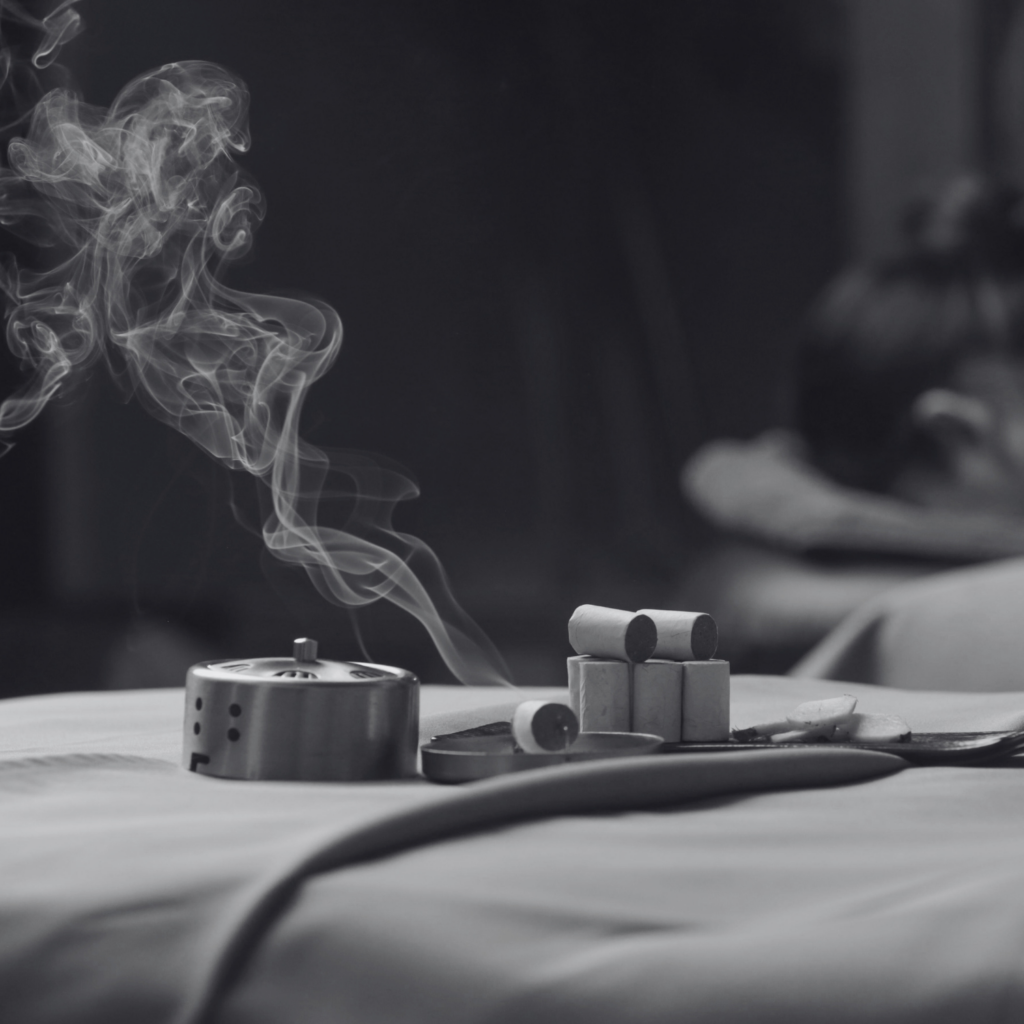
One tool we consider non-negotiable for our endo patients is moxibustion on the lower abdomen. It’s not talked about enough in the acupuncture world, but it’s one of the most powerful things we can do to support conception when endo is in the picture — especially in the luteal phase.
The TCM Lens: Moving Blood Stasis
In Traditional Chinese Medicine, endo is classically understood as blood stasis — where menstrual blood fails to flow properly and accumulates over time. Moxa applied to points like CV4 (Guanyuan) and CV6 (Qihai) works to:
- Warm the uterus — a “cold uterus” is a major barrier to conception in TCM
- Move stagnant blood (Xue Zhi) — breaking up the pathological accumulation that mirrors endometrial implants
- Tonify Kidney Yang — the root energy governing reproductive function
The Biomedical Lens: Circulation, Immunity, and Hormones
From a biomedical perspective, the sustained radiant heat from moxa offers meaningful physiological benefits. Specifically, it may:
- Reduce pro-inflammatory cytokines like IL-6 and TNF-α that drive endo lesion growth and pain
- Increase local pelvic circulation, improving endometrial receptivity and clearing inflammatory byproducts
- Support immune modulation — influencing NK cell activity and T-regulatory cell function, both of which are often dysregulated in endo
- Help normalize FSH, LH, and estrogen signaling through stimulation of lower abdominal reflex zones tied to the HPO axis
- Improve uterine tone and reduce spasm, creating a better mechanical environment for implantation
What the Research Says About Moxa + Endo
Small RCTs and observational studies show reduced dysmenorrhea (painful periods) and improved pregnancy rates when moxa combines with acupuncture. The evidence is still growing, and larger trials are needed. That said, clinically, we see a meaningful difference for our endo patients when we use it consistently — especially around the luteal phase. We’re not waiting for a meta-analysis to confirm what we witness every cycle.
Related Post: Unlocking Fertility with the Ancient Art of Moxibustion
You Are Not Alone in This
Endo affects 1 in 10 women and remains one of the most underdiagnosed, undertreated conditions in reproductive medicine. You deserve a care team that truly understands it and treats you — not just your labs.
We work with endo patients every week here in San Diego. If you’re ready to look at your full picture — your cycle, your labs, your lifestyle — we’d love to be part of your team. Text us anytime, or book your consult below. We’ve got you.
📍 Aphrodite Fertility Acupuncture | San Diego, CA | Book Your Consult
| About the author Emily Marson, L.Ac. Emily is the founder of Aphrodite Fertility Acupuncture in San Diego, California. She specializes in complex reproductive cases, combining advanced fertility acupuncture with mitochondrial health protocols, precision nutrition, and a deep knowledge of both Eastern and Western reproductive medicine. Located at 2970 5th Ave, Suite 320, San Diego, CA 92102. |



+ show Comments
- Hide Comments
add a comment