
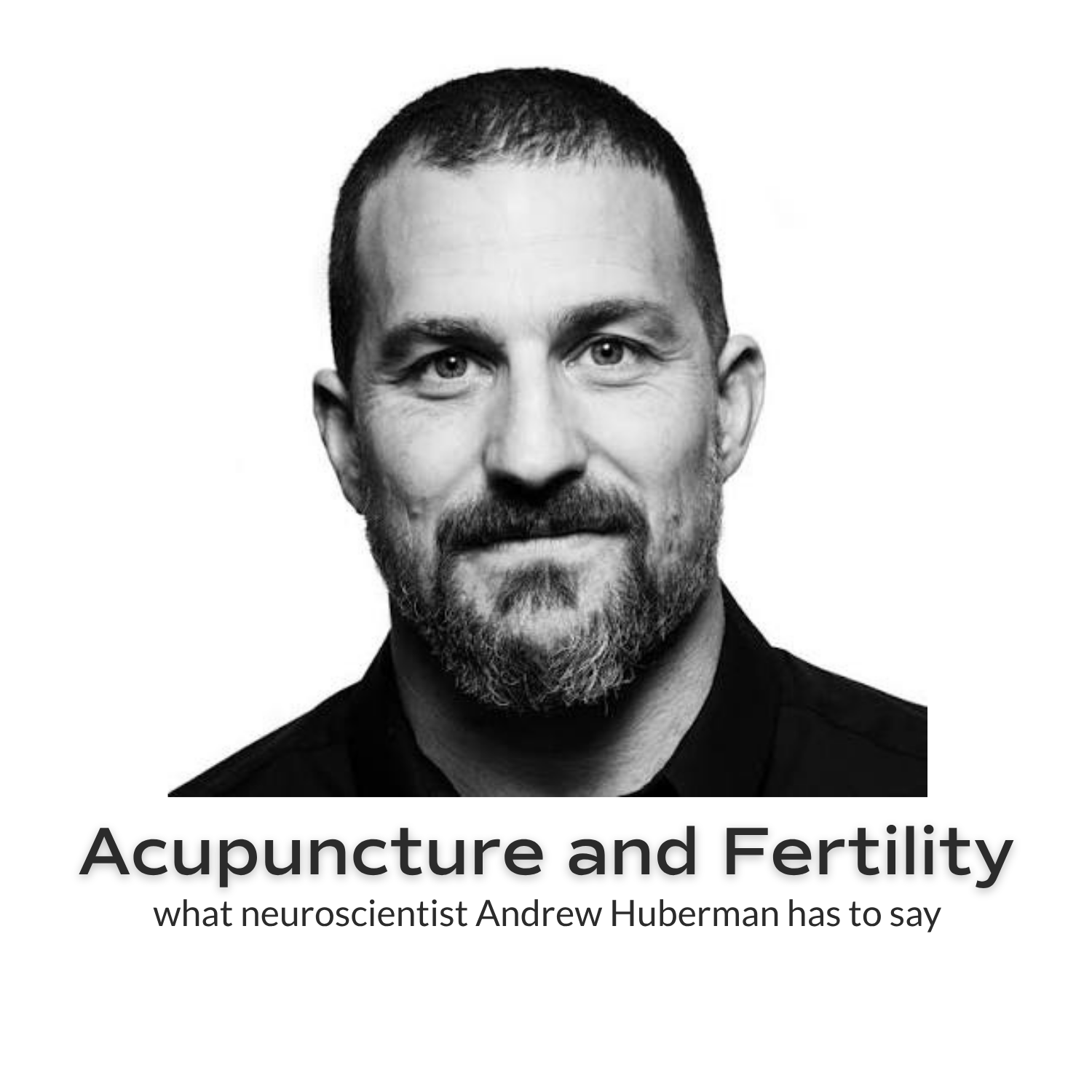

By Emily Marson, L.Ac. | Aphrodite Fertility Acupuncture, San Diego
Andrew Huberman gave acupuncture its own segment in his four-hour fertility episode, and he did not treat it as fringe. In episode 108 of the Huberman Lab podcast, “How to Optimize Fertility in Males and Females” (January 23, 2023), the Stanford neuroscientist walks through how acupuncture may influence fertility in both men and women, points listeners to peer-reviewed reviews, and credits the Harvard laboratory of Dr. Qiufu Ma for mapping how specific acupuncture points drive measurable effects in the nervous system and organs. For a mainstream science communicator with a large audience, that is a notable place to land. It also matches what we see in clinic every week in San Diego.
What Huberman actually said about acupuncture and fertility
The acupuncture section sits near the end of the episode, at the 3 hour 42 minute mark, under the heading “Acupuncture, Fertility and Pregnancy.” His framing is mechanistic rather than mystical. The Huberman Lab clip of that segment describes his point as acupuncture affecting the body’s “mechanical and chemical milieu” in ways that can support hormone production and sperm quality. In plain terms, he is talking about blood flow, nervous-system signaling, and hormone regulation, not energy in the abstract.
Two things stand out about how he handled the topic:
- He grounded it in a lab. He points to Dr. Qiufu Ma at Harvard Medical School, whose team has shown in animal studies that electroacupuncture at specific points activates defined neural pathways, including a vagal-adrenal circuit that changes the body’s inflammatory and hormonal state. That work moved acupuncture research toward measurable biology.
- He sent people to the literature. In the episode resources, he recommends a review titled “Acupuncture and herbal medicine for female infertility: An overview of systematic reviews,” published in Integrative Medicine Research. He is asking listeners to read the evidence, not take his word for it.
What the research shows, without the hype
Here is the part a good clinician has to say plainly. Huberman is enthusiastic about the mechanisms, and the mechanisms are real. .
Where the evidence is stronger
- Versus no added treatment: reviews have linked acupuncture during IVF to more clinical pregnancies and live births (relative risk around 1.30 in a widely cited analysis).
- Egg quality in older patients: a randomized trial in women over 37 found more mature eggs retrieved when acupuncture was added to IVF.
- Stress and cortisol: a 2022 randomized trial found lower cortisol in women undergoing IVF, and a 2025 University Hospitals study found meaningful drops in anxiety, stress, and pain after a single session.
Where it is weaker
- Versus sham needling: when acupuncture is compared with a placebo needling procedure, most of the difference fades.
So the fair reading of Huberman’s segment is this: acupuncture has plausible biology and real supporting data for specific groups, and it is not a guarantee of a baby. That is exactly how we talk about it with patients.
How this plays out in a San Diego fertility practice
The mechanisms Huberman describes are the ones we work with directly. Better blood flow to the ovaries and uterus, a calmer stress axis before egg retrieval and embryo transfer, and hormone regulation across the cycle. We start egg and sperm quality work in the 90 days before an IVF stimulation, because that is the window when developing follicles and new sperm are most responsive. During a cycle we time sessions to your protocol and offer on-site acupuncture on the day of frozen embryo transfer.
Over eight years I have helped more than 1,000 San Diego women conceive, and Aphrodite partners with every major fertility clinic in the city. When a patient brings up a podcast episode like this one, my job is to separate the mechanism from the promise: use what the biology supports and coordinate with your reproductive endocrinologist.
Frequently asked questions
Did Andrew Huberman really endorse acupuncture for fertility?
He devoted a segment of episode 108 to it and described plausible mechanisms, crediting Dr. Qiufu Ma’s Harvard lab and recommending a peer-reviewed review. He framed it as mechanism-backed and worth understanding, not as a guaranteed treatment.
What did he say the mechanism was?
He described acupuncture influencing the body’s mechanical and chemical environment: blood flow, nervous-system signaling, and hormone regulation, with effects on sperm quality and hormone production.
Who is Qiufu Ma and why does he matter here?
Dr. Qiufu Ma is a Harvard Medical School researcher whose team showed that electroacupuncture at specific points activates defined neural circuits, including a vagal-adrenal pathway. His work helped move acupuncture into measurable neuroscience.
Does the science prove acupuncture increases IVF success?
Compared with no added treatment it has been linked to more pregnancies and live births, and it lowers stress hormones. Compared with sham needling the difference is small. The strongest signal is in women over 37 and poor responders.
Can I combine acupuncture with my IVF cycle in San Diego?
Yes. We coordinate with your fertility clinic, time sessions to your protocol, and provide on-site acupuncture for embryo transfer.
Ready to find your answers?
If Huberman’s episode got you curious, let’s talk about what actually applies to your cycle. Book online at https://aphrodite.janeapp.com/ or call 858.333.7688. New patient visits are $250 and returns are $118, with HSA and FSA accepted and superbills provided. You may also want our guide to supplements for egg quality and our 90-day IVF preparation plan.
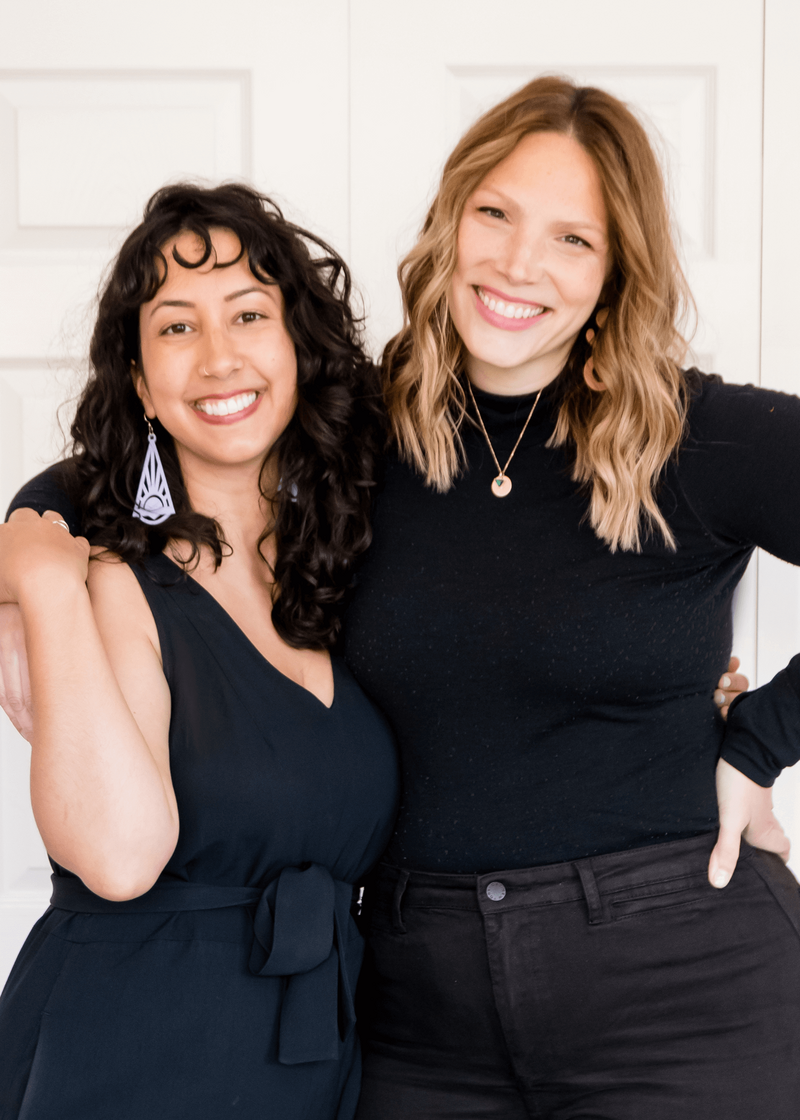
Emily Marson, L.Ac., is the founder of Aphrodite Fertility Acupuncture. She has spent more than eight years helping San Diego women conceive and works alongside every major fertility clinic in the city. Located at 2970 Fifth Ave, Suite 320, San Diego, CA 92103.

+ show Comments
- Hide Comments
add a comment